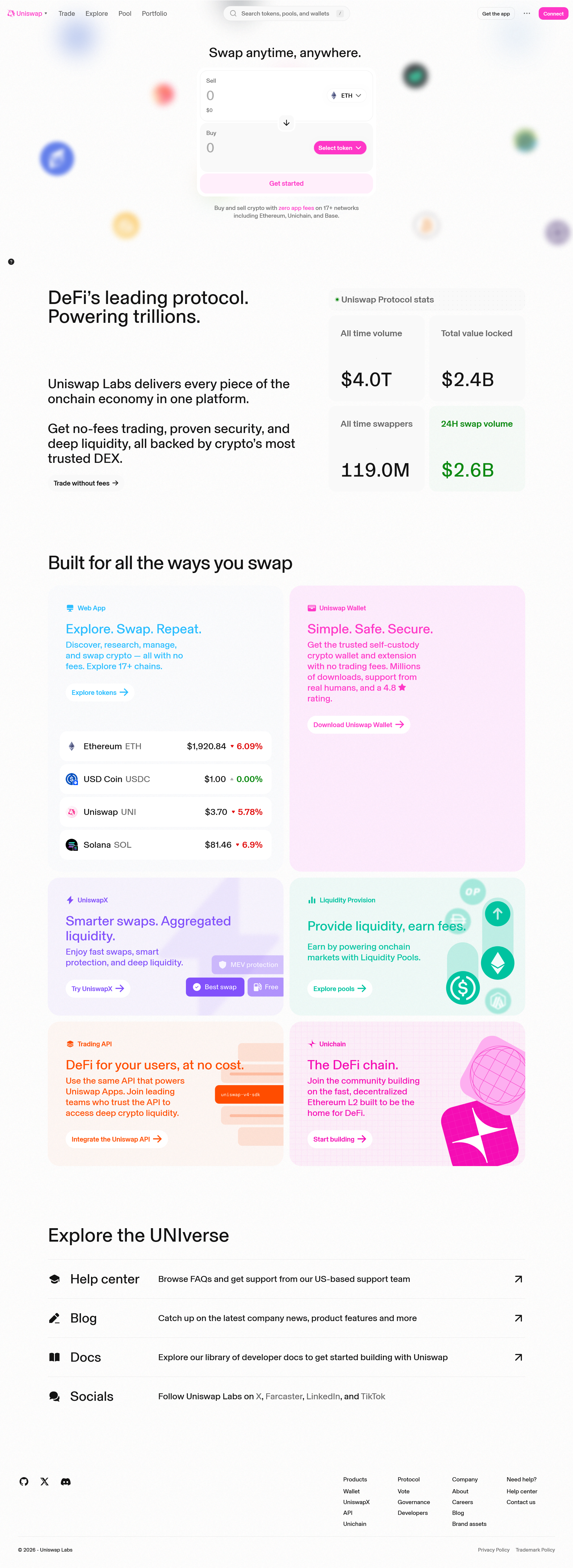
In the evolving landscape of decentralized finance (DeFi), few protocols have had as much impact as Uniswap. Built on the Ethereum blockchain, Uniswap revolutionized how cryptocurrencies are traded by eliminating centralized intermediaries and enabling peer-to-peer token swaps through automated smart contracts. Since its launch in 2018, it has become one of the most influential decentralized exchanges (DEXs) in the crypto ecosystem.
What Is Uniswap ?
Uniswap is a decentralized exchange protocol that allows users to trade cryptocurrencies directly from their wallets without relying on centralized platforms. Instead of using traditional order books like centralized exchanges, Uniswap operates through automated liquidity pools powered by smart contracts.
The protocol was created by Hayden Adams and inspired by ideas proposed by Vitalik Buterin. Its goal was to create an open and permissionless trading system where anyone could swap tokens, provide liquidity, or build applications on top of the protocol.
How Uniswap Works
At the heart of Uniswap is the Automated Market Maker (AMM) model. Instead of matching buyers and sellers, the system uses liquidity pools filled with token pairs. Users trade against these pools rather than against other traders.
Key components include:
1. Liquidity Pools :-
Liquidity pools are collections of two tokens locked in a smart contract. For example, a pool may contain ETH and USDC. These pools provide the liquidity needed for trading.
Users known as liquidity providers (LPs) deposit equal values of both tokens into a pool and earn a share of the trading fees.
2. Automated Pricing :-
Uniswap uses a mathematical formula called the constant product formula:
x × y = k
Where:
. x = amount of token A
. y = amount of token B
. k = constant value
This formula automatically determines token prices based on supply and demand within the pool.
3. Smart Contracts :-
All transactions on Uniswap are executed through smart contracts on the Ethereum blockchain. This ensures transparency and removes the need for centralized control.
The Role of the UNI Token
In 2020, Uniswap introduced its governance token, UNI. The token allows holders to participate in the governance of the protocol.
UNI holders can vote on proposals such as:
. Protocol upgrades
. Fee structures
. Treasury spending
. Future development directions
This governance model gives the community influence over how the protocol evolves.
Major Versions of Uniswap
The protocol has evolved through several major upgrades:
Uniswap V1
The original version introduced the AMM model but supported only ETH token pairs.
Uniswap V2
Released in 2020, this version enabled direct ERC-20 token-to-token swaps and improved pricing mechanisms.
Uniswap V3
Launched in 2021, Uniswap V3 introduced concentrated liquidity, allowing liquidity providers to allocate funds within specific price ranges. This dramatically increased capital efficiency.
Advantages of Uniswap
Uniswap offers several benefits compared to traditional exchanges:
1. Permissionless Access
Anyone with a crypto wallet can trade without registration or identity verification.
2. Non-custodial Trading
Users maintain control of their funds because trades occur directly from their wallets.
3. Transparency
All transactions and liquidity pools are visible on the blockchain.
4. Innovation Platform
Many DeFi projects launch their tokens through Uniswap due to its open and accessible infrastructure.
Risks and Challenges
Despite its advantages, Uniswap also presents certain risks:
. Impermanent loss for liquidity providers
. Smart contract vulnerabilities
. High gas fees during network congestion on Ethereum
. Scam or low-quality tokens being listed due to permissionless listings
Users must conduct proper research before interacting with new tokens or liquidity pools.
Uniswap’s Impact on DeFi
Uniswap has played a critical role in the growth of decentralized finance. By demonstrating that markets can operate without centralized order books, it paved the way for many other AMM-based exchanges.
Its model has inspired competitors such as SushiSwap and PancakeSwap, as well as numerous innovations across the DeFi sector.
The Future of Uniswap
As DeFi continues to expand, Uniswap is exploring improvements such as:
. Layer-2 scaling integrations
. Cross-chain liquidity solutions
. Enhanced liquidity provider tools
. Further governance decentralization
With billions of dollars in liquidity and a vibrant developer ecosystem, Uniswap remains one of the most influential infrastructures in the decentralized financial world.
✅ Conclusion
Uniswap has fundamentally transformed cryptocurrency trading by introducing automated market makers and decentralized liquidity pools. Its open, transparent, and permissionless approach has made it a cornerstone of the DeFi movement. As blockchain technology advances, Uniswap is likely to remain a key platform shaping the future of decentralized finance.

Drag & Drop Website Builder